
Critical thinking ✅ development of thinking ✅ skills of the XXI century
Critical thinking and development of thinking
The modern world raises a huge number of questions for a person every day, which cannot be answered only with the help of memorized rules and ready-made formulas. Information is constantly changing, new technologies, professions, sources of knowledge and ways of communication are emerging. The child today gets access to much more information than any previous generation. However, the mere presence of
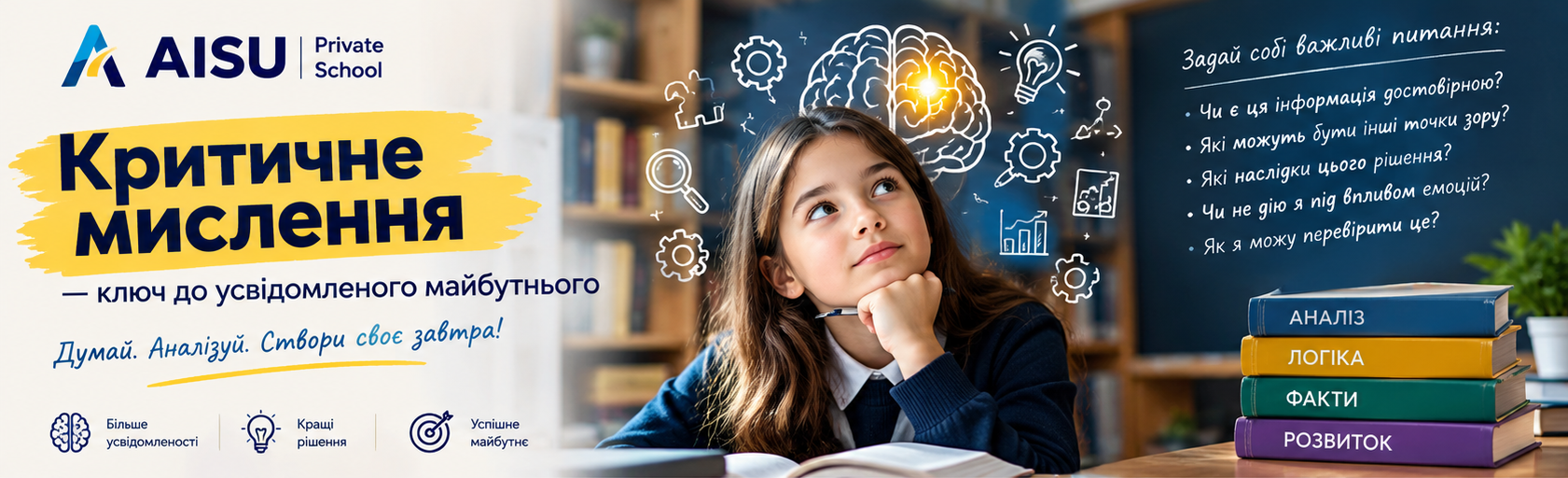 information does not mean that a person knows how to use it correctly. You can know a lot of facts, but you can’t distinguish a fact from an assumption, an argument from manipulation, a reliable source from an unreliable one, and your own opinion from a conclusion that is really supported by evidence. That is why one of the key tasks of modern education is not only the transfer of knowledge, but also the formation of the child’s ability to think independently. A special place here is occupied by critical thinking – a complex of intellectual skills that helps a person to ask the right questions, analyze information, evaluate arguments, find cause-and-effect relationships, consider the problem from different angles, notice contradictions and draw reasonable conclusions.
What is critical thinking?
Critical thinking is the ability of a person not just to perceive information, but to actively comprehend, analyze and evaluate it. It involves a willingness to question a statement if there is not enough evidence for it, check the source of information, separate facts from interpretations, see hidden assumptions, and consider alternative explanations. At the same time, critical thinking does not mean constantly denying everything that the other person says. On the contrary, a person with a developed critical mindset can agree with a certain statement if it has sufficient justification. The main difference is that her consent is based not only on authority, popularity, or emotional impression, but also on the analysis of information and arguments.
For a child, the development of critical thinking means a gradual transition from the position “I was told – so it’s true«to the position “I want to understand why this is true, what this statement is based on, and whether there are other possible explanations”. Such a change seems simple only at first glance. In fact, it is fundamental for the formation of an independent personality. A child who can analyze information doesn’t just perform better on learning tasks. They gradually acquire the ability to navigate difficult life situations, make decisions, defend their position in a reasoned manner and at the same time remain open to new information.
Why is critical thinking so important for a modern child?
One of the main reasons is the information environment in which children grow up today. The internet has opened up almost unlimited access to knowledge, but along with useful information, a person faces mistakes, unverified statements, exaggerations, advertising, manipulative content and conflicting views. It’s not enough for a child to just learn how to use a search engine. She must understand how to evaluate what she has found. You need to be able to ask questions: Who is the author of the information, what is its purpose, where the data is taken from, whether they are confirmed by other sources, whether words are not taken out of context, whether facts are not replaced by emotions. These skills become a kind of intellectual protection of a person in the information space.
It is especially important that critical thinking is not formed automatically just because the child reads a lot or gets good grades. You can remember the material perfectly and at the same time analyze it not deeply enough. That is why a modern school should create situations in which the student not only answers the teacher’s questions, but also asks questions himself, explains his own reasoning, compares different options, justifies his answer, looks for evidence and can change his position after receiving new information.
Does critical thinking mean the ability to doubt everything?
No. Critical thinking has nothing to do with constant distrust or a desire to challenge the other person. Its purpose is not to find flaws in each statement, but to understand how well it is justified. If the claim is supported by strong evidence, critical thinking helps to recognize it. If there is not enough evidence, it tells you not to rush to a conclusion. If there are several possible explanations, it encourages you to consider them and compare them.
That is why a critical person can say: “I agree because I see enough evidence, “or:«I can’t decide yet because there isn’t enough information.«The ability to remain unsure until there are sufficient grounds for conclusion is an important intellectual skill. It helps to avoid hasty decisions and teaches the child to understand that not every question has an instant and unambiguous answer.
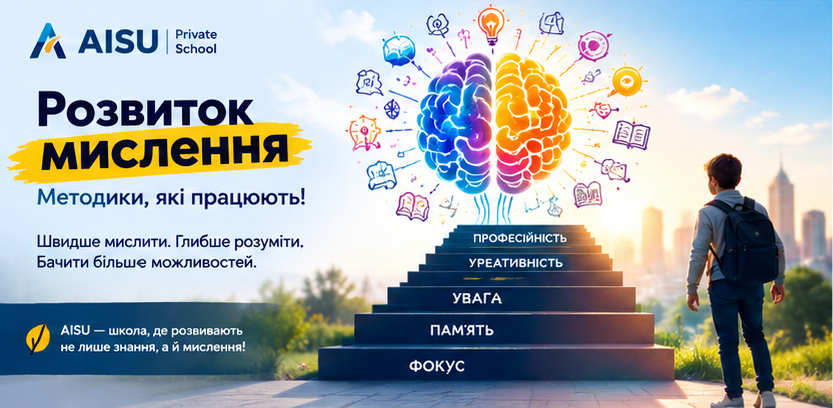 How does critical thinking differ from logical thinking?
Logical thinking and critical thinking are closely related, but not completely identical. Logical thinking helps you build consistent reasoning, find patterns, and understand the relationships between statements. Critical thinking is a broader concept: it involves logical analysis, but also involves evaluating information sources, evidence, context, assumptions, and alternative views.
For example, a person can logically construct an argument, but if the source information is false, the logical sequence itself will not make the conclusion correct. Therefore, it is important for the child to learn not only to ask «Is this conclusion logical?”, but also «is the source data correct?”, “Where did they come from?”, “is important information missed?». It is the combination of logic, attention to evidence, and a willingness to test your own assumptions that creates the basis for critical thinking.
Why is the ability to ask questions part of critical thinking?
Qualitative thinking almost always starts with a qualitative question. If the child is used to receiving only ready-made answers, they may gradually lose the need to investigate the problem on their own. But the question is «why?”How do we know that?”, “what happens if?”, “what other options are there?”can I check this?”open the way to a deeper understanding.
For example, instead of simply telling the student that a certain historical event had specific consequences, you can ask: “why exactly did these consequences arise?”, “what other factors could have affected them?”, “how would the situation have changed in a different development of events?». In this case, the student does not just remember the fact, but begins to investigate cause-and-effect relationships. It is these intellectual actions that gradually form the habit of thinking more deeply.
Should a child be allowed to question the words of adults?
The development of critical thinking suggests that the child should learn to ask questions even to the information that he receives from authoritative people. This does not mean cultivating disrespect. On the contrary, the child can learn to express doubts culturally and argumentatively: “can we check this?”, “and how do you know that this is exactly the case?”, “is there any other explanation?».
This is how an important distinction is formed between blind trust and justified trust. The child gradually understands that the authority of a person in itself is not proof of the truth of each of his statements, but at the same time learns to evaluate information without unfounded denial.
Can Critical Thinking be taught?
Critical thinking develops through systematic practice. It doesn’t appear after one lesson or several logical tasks. The child needs regular opportunities to analyze, ask questions, make mistakes, test their own assumptions, discuss various positions, and explain the path to conclusion.
The teacher plays an important role here. The teacher can not just tell you the correct answer, but ask additional questions: “why do you think so?”, “what evidence confirms this?”, “is it possible to solve the problem in another way?”, “what would change if we changed one condition?». Due to the regular use of such questions, the thinking process gradually becomes familiar to the child.
Development of thinking: What does it mean?
Developing thinking is not just about training your memory or ability to answer questions quickly. This is a much broader process that encompasses the formation of the ability to analyze, compare, generalize, establish patterns, find cause-and-effect relationships, generate ideas, plan actions, predict results, and find solutions to new problems.
Thinking can be conditionally considered as a system of various intellectual skills. Logical thinking helps you build consistent reasoning. Analytical – to break down a complex problem into parts. Creative-create new ideas. System-see the relationships between elements. Critical-evaluate information, evidence, and arguments. Flexible thinking helps you change your strategy if the previous method doesn’t work.
That is why the development of thinking in a modern school should be multicomponent. There is no single exercise that automatically develops all intellectual abilities. A combination of different methods is required.
Is it possible to develop thinking quickly?
The expression “rapid development of thinking«should be understood correctly. There is no universal exercise that radically changes a person’s intellectual abilities in a few days. At the same time, regular targeted exercises can quickly help your child develop new ways to work with information and solve problems.
For example, if a student regularly practices searching for alternative solutions, they gradually start automatically searching for not one, but several options. If they systematically explain their own way of solving the problem, they are better aware of their own strategies. If you constantly work with different sources, you gradually begin to pay attention to authorship, argumentation, and evidence.
Therefore, the speed of development of individual skills depends primarily on the consistency and quality of practice.
Methodology # 1.Socratic questioning.
Socratic questioning is a method of building a dialogue through sequential questions that help a person independently explore their own statement.
Instead of immediately telling the child that he is wrong, the teacher may ask: “why do you think so?”, “what facts confirm your opinion?”, “can there be another explanation?”what must be true for your conclusion to be correct?». So the child gradually learns to analyze his own reasoning.
The value of this technique lies in the fact that it develops not only knowledge, but also intellectual independence. The student begins to understand that the answer must not just exist – it must be justified.
Methodology # 2.Problem-Based Learning.
Problem-based learning involves a situation in which the child is not given a ready-made solution algorithm. She is offered a problem that needs to be investigated.
For example, instead of a ready-made explanation of a natural phenomenon, students can be asked the question: “why does one plant grow faster than another?”children make assumptions, identify possible factors, discuss verification methods, conduct observations, and formulate conclusions.
This approach is especially valuable because the child learns to act in conditions of uncertainty. She understands that a complex problem does not always have a ready-made algorithm, which means that you must first formulate the problem correctly, and only then look for a solution.
Methodology # 3.project training.
Project activity combines knowledge and practice. The student receives a specific topic or problem and must independently go from asking a question to presenting the result.
During the project, the child can search for information, conduct research, communicate with other participants, analyze data, create their own product and present it. It is important that the end result is not only an assessment, but also a certain result of the activity: research, presentation, model, layout, video, text, experiment or other product.
Project work develops a set of skills simultaneously: planning, responsibility, analysis, creativity, communication and the ability to bring work to completion.
Methodology #4.debates and reasoned discussions.
Debates teach the child to understand that opinion and argument are not the same thing. Anyone can have a position, but it can only be convincingly explained when there are logical arguments and proofs.
During debates, the student learns to listen to the other person’s position, find the main thesis in it, analyze arguments and formulate an answer. At the same time, it is important not to “defeat«the interlocutor, but to learn how to conduct an intellectual dialogue.
This technique also helps to develop the ability to change your own position if the other party’s arguments are more convincing. This is an important part of mature thinking.
Methodology # 5. brainstorming.
Brainstorming is primarily aimed at developing divergent, i.e. multivariate, thinking. The child is offered a problem for which you can come up with many different solutions.
At the first stage, it is important not to evaluate ideas. The challenge is to create as many options as possible. In the second stage, ideas are analyzed, grouped, compared, and improved.
This is how a child learns to separate two processes: generating ideas and evaluating them. This is important for both creativity and critical analysis.
Methodology # 6. Smart cards.
Smart cards help you organize information in the form of a system of interrelated concepts. Instead of a long linear list, the child sees a central topic, main categories, and related details.
This method is especially useful when working with large topics. The student can see not only individual facts, but also connections between them. This makes information more structured and complex concepts easier to analyze.
Technique # 7. “Six Thinking Hats”.
The method of Edward De Bono suggests consciously considering the problem from different perspectives. Within this approach, different “hats«symbolize different ways of thinking: working with facts, emotions, risks, benefits, creative ideas, and organizing the process itself.
For example, when discussing a particular idea, students can first identify the facts, then talk about potential risks, then look for benefits, and then come up with alternative solutions. This structure helps to avoid situations where a person evaluates the problem only from one side.
Methodology # 8. argument analysis.
To develop critical thinking, it is useful to offer students statements and ask them to break them down into components.
The child can identify the main thesis, arguments, examples, proofs, assumptions, and possible counterarguments. Gradually, she begins to see the difference between a convincing argument and just an emotional phrase.
For example, the statement “This method of training is the best, because it is used by everyone«allows you to ask a few questions: Is it really used by everyone, does popularity mean efficiency, for whom this method is the best, and what is the evidence of its effectiveness.
Methodology # 9. search for alternative explanations.
This technique helps to combat hasty conclusions.
The student is offered a situation for which one explanation seems obvious. Its task is to come up with at least a few other options.
For example, if a child arrived later than others, you don’t automatically assume that they were late due to inattention. There may be different circumstances. The task helps you see that the same situation can have several causes.
Method # 10.working with an error.
An error can be a powerful learning tool if you analyze not only the wrong result, but also the path that led to it.
The student can be offered an already completed task with an error and ask the question: “at what stage did the problem arise?”, “what rule was applied incorrectly?”, “what was needed to be checked?».
This format develops the ability to analyze not only your own results, but also the thinking process of another person.
Methodology #11. hypotheses and their verification.
The student receives the problem and formulates an assumption about why a certain phenomenon occurs.
For example:
«I assume the reason is in…»
After that, you need to define:
«How can we verify this assumption?»
This approach is the basis of research thinking. It teaches the child to separate assumptions and proven facts.
Method # 12. Method «what happens if?».
This method is aimed at developing forecasting.
The student is asked to change one condition and predict the consequences.
«What happens if the trees disappear?»
“What will change if the temperature rises?»
«What happens if you change the rule?»
«How will the result change if one of the factors is removed?»
The child learns to build cause-and-effect chains, and not to consider phenomena as a set of unrelated facts.
Methodology #13. classification.
Classification helps to develop the ability to find common and distinctive characteristics.
Students can be offered a set of subjects, concepts, or phenomena and asked to divide them into groups. After that, it is important to ask an additional question:
«Can they be classified differently?»
It is the second part of the task that develops flexibility of thinking especially well, because the child sees that one information can be structured according to different criteria.
Methodology #14. comparison.
Comparison is one of the fundamental operations of thinking.
But for the development of thinking, it is important not to limit yourself to the question «How do they differ?».
It is more useful to ask more complex questions:
«What do they have in common?»
«What is the most important difference?»
«Can I change the comparison criterion?»
«How are they similar, although at first glance they seem completely different?»
This is how the child learns to analyze objects at different levels.
Methodology #15.role situations.
Role-playing tasks help you look at the same problem from the perspective of different people.
For example, when discussing the creation of a new urban space, one group may represent residents, another – entrepreneurs, a third – environmentalists, and a fourth – parents with children.
Each group will have its own arguments and priorities. The child sees that complex questions can have several reasonable prospects.
This develops flexibility, consistency, and the ability to understand the other person’s position.
Methodology #16.working with information sources.
A Modern child should learn not just to find information, but to evaluate its quality.
To do this, you can compare several sources on the same topic and analyze who the author is, when the material was created, what evidence is provided, what sources are used, and whether there is a clear division between facts and assessments in the text.
This is how information literacy is formed – one of the important components of critical thinking.
Methodology #17. metacognition.
Metacognition means awareness of one’s own thinking process.
After completing the task, the child can be asked not just to name the answer, but to explain:
«How did you solve this?»
“What was the most difficult part?»
«What strategy did you use?»
“what worked?»
“What can be done differently next time?»
So the student gradually becomes more aware of their own learning.
Methodology #18.logical problems and puzzles.
Logical problems help to train the sequence of reasoning, the search for patterns, the analysis of conditions and the ability to work with constraints.
But it is especially important to ask after the solution:
«How did you find the solution?»
If a child has learned to explain their own strategy, they get much more than just the right answer.
Methodology No. 19.intersubject training.
The intersubject approach allows you to show the child that real problems are not divided into separate school subjects.
For example, the topic of ecology can simultaneously include biology, chemistry, geography, mathematics, technology, a foreign language, and communication.
The student begins to see how knowledge from different disciplines can work together to solve the same problem.
Methodology # 20. learning through real cases.
A case is a specific situation that needs to be analyzed and resolved.
For example, students may be offered a situation in which a particular organization needs to solve a problem with limited resources.
The child must determine what information is needed, what options exist, what risks each of them has, and how the proposed solution can be verified.
Such tasks bring learning closer to real life.
How does the combination of techniques affect the child’s development?
The greatest potential is not the isolated use of one technique, but a combination of them.
For example, during a single educational project, students can first brainstorm, then form hypotheses, find information, check sources, analyze arguments, conduct practical research, discuss the results in a group, and present their own conclusion.
In this case, different components of thinking work simultaneously.
The child generates ideas, analyzes, checks, compares, collaborates, argues, and reflects.
It is an integrated approach that allows you to make the development of thinking a part of the daily educational process, and not a separate episode.
How does AISU private school develop students ‘ critical and systematic thinking?
At AISU private school, we are convinced that modern education should help children not only accumulate knowledge, but also learn how to use it. That is why developing thinking is an important part of our educational approach. We strive to create an environment in which the student can ask questions, research, make their own assumptions, analyze information, work with other students, find solutions, and explain the logic of their conclusions.
In the AISU educational process, we use various educational methods and formats of work that are aimed at developing critical, logical, creative, analytical and systematic thinking. It is important for us that the child does not remain a passive listener. We strive to involve them in active work with information and create learning situations in which you need not just to reproduce the material, but to use the knowledge to solve the problem.
Projects as a space for independent thinking in AISU.
Project activity is one of the formats that allow students to apply their knowledge in practice. While working on a project, the child can go from a question and Idea to a specific result. They must identify the problem, find the necessary information, analyze it, distribute tasks, offer solutions, and present results.
We see a special value in the fact that the project allows us to combine knowledge from different academic fields. The student can use mathematical calculations, natural knowledge, language skills, digital tools, creativity, and communication within a single task.
So learning becomes not only the assimilation of material, but the process of creating your own result.
Research and questions instead of ready-made answers.
At AISU, we strive to maintain a culture of questions.
It is important for us that the child can ask:
- «Why?»
- «How does it work?»
- «What happens if?»
- «How do I check this?»
- «Is there another solution?»
Such questions are a natural part of the learning process.
The student gradually realizes that ignorance of the answer is not a problem if there is a willingness to explore it. This is what shapes the research approach to learning.
Argumentation and discussion.
We also pay attention to the ability to express our own opinions and explain them.
Phrase:
- «I think so»
- Is just the beginning.
- The next step should be:
- « I think so, because…»
The child learns to formulate arguments, give examples, listen to other positions and answer questions.
This is how a culture of dialogue is gradually formed, in which different opinions can be the subject of discussion, and not the cause of conflict.
Creativity and critical analysis.
At AISU, we view creative and critical thinking as complementary skills.
First, the child should be allowed to create a lot of ideas.
Then-teach them to evaluate them.
For example, while working on a particular problem, students can suggest ten possible solutions. The next step is to analyze which ones are realistic, which ones require additional resources, which ones have risks, and which ones can give the best result in a particular situation.
This is how the full cycle is formed:
Idea → analysis → verification → improvement → result.
Teamwork and development of thinking.
Teamwork is also an important part of the educational process.
When several students work on a common task, they are faced with different thoughts, solutions, and approaches. They need to listen to each other, argue their own suggestions, negotiate, distribute tasks, and be jointly responsible for the result.
Such situations develop not only communication skills, but also intellectual flexibility.
The student sees that another person can offer a solution that they didn’t think of themselves.
Intersubject approach in AISU.
We strive to show students the connection between different branches of knowledge.
Math may be needed to investigate a real problem.
Foreign language-for working with international sources.
Natural Sciences-to explain the phenomenon.
Technologies – for creating a product.
Art – for its visual representation.
Communication – to present the result.
This approach helps the child to see the practical value of knowledge and understand that academic disciplines can complement each other.
Working with information and the digital environment.
A modern student should be able to work with a huge amount of information.
Therefore, we consider it important to develop not only search skills, but also analysis skills.
It is important for the child to gradually learn to ask:
- Who created this information?
- What is the purpose of this material?
- What is the basis of the statement?
- Can I check the data provided?
- Are there any other sources?
- Are the facts and Estimates Mixed here?
Such questions help to form a responsible attitude to information.
Error as part of training.
We believe that error can be an important part of the educational process.
Instead of treating an incorrect answer only as a failure, one can investigate why it occurred.
- What did the child know?
- What assumption did you make?
- Where exactly did the logic change?
- What can be done differently?
This approach helps the child not to be afraid of complex tasks and gradually forms the habit of analyzing their own actions.
Why do we use so many different techniques at AISU?
We do not believe that one technique can develop all types of thinking equally effectively.
That is why the educational process can combine project activities, problem-based learning, research, discussions, teamwork, brainstorming, logical tasks, working with information sources, creative tasks, intersubject projects and reflection.
Each of these approaches works with its own development component.
One helps generate ideas.
The second is to analyze.
The third is to argue.
The fourth is to explore.
The fifth is to see the problem from a different angle.
The sixth is to evaluate your own decisions.
Together, they create a diverse intellectual environment.
What result do we want to see?
For AISU, the development of thinking is not the desire to teach a child to answer as many complex questions as possible.
It is much more important that the child gradually learns to work independently with questions.
So that she can say:
- “I know because I can explain it”.
- “I do not know, but I know how to explore it”.
- “I have my own opinion, and I can justify it”.
- “I have heard a different position and can analyze it”.
- “I made a mistake, understood the reason and can try again”.
- “I see several possible solutions and can compare them”.
These are the skills we consider an important part of modern education.
Critical thinking as a skill for the future.
A Child today cannot know what a specific profession will be, which he will choose in ten or fifteen years. It is impossible to predict what technologies will appear, what professions will be transformed, and what knowledge will become the most popular.
But you can help your child develop the ability to learn throughout life.
Critical thinking, creative thinking, logic, the ability to analyze information, work with problems, collaborate and adapt to new conditions are skills that are not tied to one profession.
That is why the development of thinking is not an additional option to education.
This is one of its foundations.
Critical thinking begins with a simple question:
«How do we know that?»
But gradually it turns into a whole system of intellectual habits: analyze information, check sources, look for evidence, see cause-and-effect relationships, compare different points of view, ask clarifying questions, formulate hypotheses, test assumptions, admit your own mistakes and be ready to review the conclusion if new information appears.
The development of thinking, in turn, requires systematic work. Logical tasks, Research tasks, projects, discussions, debates, brainstorming sessions, smart maps, case studies, role situations, information analysis, metacognitive exercises, and intersubject projects can become tools for developing various intellectual skills.
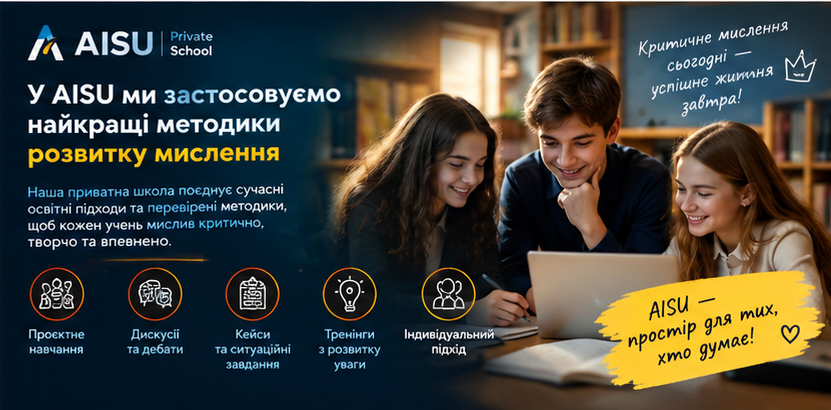 At AISU private school, we strive to combine different educational methods so that the child does not just get knowledge, but learns to work with it. It is important for us that the student can research, ask questions, compare, analyze, create, argue, collaborate, and find solutions independently.
We are convinced that a strong modern education is not only the answer to the question «What does a child know?»
Equally important questions:
- «How does she think?»
- «How does she learn?»
- «How does it find a solution?»
- «How does it verify information?»
- «How does it behave when there is no ready answer?»
It is the ability to think independently, learn, explore and draw informed conclusions that helps the child gradually become an independent person, ready for a complex, dynamic and information-rich world.
AISU is an educational environment in which knowledge becomes the basis for thinking, and thinking becomes the basis for independent development of the child.
m. Kyiv, Drahomanova 1-B, AISU
p. Khodosivka, str. Feodosiya Pecherskyi, 55


