
Vyshyvanka Day
Vyshyvanka Day-May 15. Sacred heritage of ancestors
Traditions of ancient words’Yang. amulets, symbols and sacred embroidery
Vyshyvanka Day is not just a celebration of national clothing. This is a deep connection with our ancestors, with their philosophy, worldview, belief in the power of symbols and the eternal movement of energies. Vyshyvanka is not just a decorative element, but a real code of life, encrypted in patterns that have been passed down from generation to generation.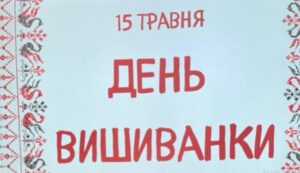
The ancient Slavs were deeply spiritual people who saw in everything the relationship between the world of people and the world of invisible forces – spirits, nature, ancestors. Clothing was not only a means of cover for them, but also a protection, a personal shield from all evil. Of particular importance were embroidered amulet shirts, which were worn from birth to death. They were passed down in the family as an inheritance and had an extraordinary energy power.
What did our ancestors embroider?
On vyshyvankas embroidered not just beautiful patterns. Each symbol had a deep meaning. All the ornaments had a sacred purpose-to protect a person, to strengthen his connection with the family, nature, and divine forces.
- Sun symbols are the most common in ornaments. Circles, swastikas, and stars are all variations of solar energy symbols. They symbolized life, movement, rebirth, warmth and strength.
- The Tree of life is the central image in the Slavic worldview. It connected three worlds: the roots – underground, the trunk – earthly, the crown – heavenly. This symbol was embroidered on the chest or sleeves – as a symbol of ancestral memory, procreation, and fortitude.
- Geometric patterns – rhombuses, crosses, spirals-had a protective function. They “confused” evil, did not allow it to penetrate the body or soul of a person. Each pattern is a kind of code, like a shield that does not allow negative energy to pass through.
Female and male characters:
Women’s vyshyvankas were dominated by images of fertility, motherhood, home protection and children. Rhombuses with a dot inside were often embroidered – a symbol of the feminine principle, the womb, and the fertile land.
Men’s vyshyvankas are mainly symbols of strength, spirit, protection and victory. Here you can see crosses, lightning bolts, swords, wolf teeth. They were intended to give a man courage, endurance and connection with his warrior ancestors.
Colors had the following values:
- Red is the color of life, energy, blood, and protection.
- Black-land, fertility, wisdom.
- White – light, purity, spirituality.
- Blue – sky, calm, connection with higher forces.
- Green – spring, rebirth, youth.
Every stitch, every shade carried information. Vyshyvanka was like a magical document, which could only be read by those who had knowledge.
Magic of symbols-energy, space and physics of embroidery.
When we look at Vyshyvanka, we see an ornament. But in reality, these are waves of energy, a swirling spiral of information encoded in symbols. Our ancestors of the Slavs had extraordinary knowledge-in astronomy, geometry, and energy. They intuitively felt that modern science was just beginning to discover.
Energy carrier symbols:
every shape, every line is a wave. The geometry of the ornament contains frequency characteristics: as in music or light. A circle is a wave that has no beginning and no end, it harmonizes. The spiral is a symbol of development, the movement of energy from the core to the outside. A rhombus is a shape that holds energy and directs it.
Symbols embroidered on certain areas of the body (chest, throat, arms) – directed and protected the energy of vital centers. So, for example, embroidery on the chest preserved the heart chakra, and embroidery on the collar – protected the voice, word, thought.
Twisting of Space-Spiral and cosmic energy. The Slavs were well aware that the world is not static. Everything is in motion, in rotation, in a spiral. They transferred this spiral to the fabric. We see the same helices in DNA, in galaxies, in tornadoes. The spiral is the universal code of life. And when a person put on an embroidered shirt with a spiral, it seemed to synchronize with the entire universe.
Magic + physics = Vyshyvanka. At the energy level, Vyshyvanka works as an antenna. It captures, stores, and transmits energy. Therefore, ancient craftswomen never embroidered in a bad mood, never took up the needle in a state of anger – because embroidery absorbs everything, both positive and negative.
Scientists today talk about information fields, vibration frequencies, torsion fields – and the Slavs already embroidered these fields on shirts hundreds of years ago. They knew how to stabilize space, how to protect a person, how to maintain harmony between body, soul and the world around them.
Our ancestors are carriers of great knowledge. The Slavs were not primitive pagans. They had deep knowledge, which they embodied in seemingly ordinary things. Vyshyvanka is a sacred code where magic and Science, Energy and aesthetics are combined. And every thread in it is a bridge between us and our ancestors.
Vyshyvanka Day is not just an occasion to wear a shirt. This is a day of feeling your roots, your connection with the ancient and eternal. Each embroidery contains history, protection, and wisdom. And the more we understand its symbols, the closer we get to our true selves. The Slavs left us not only clothes, but a whole philosophy of life, encoded in colors, patterns and shapes. And this is the real magic of the Ukrainian soul.
Day of national traditions and values of Ukrainians for 2025
In a rapidly changing world, where artificial intelligence is developing on a par with human consciousness, and globalization is blurring the boundaries between nations every day, Ukrainians are increasingly striving for their own – authentic, real, Native. In 2025, the day of national traditions and values takes on a new, deeper meaning. This is no longer just a date in the calendar, but a mirror of the nation, its soul, its future.
Ukrainians today are a nation that has withstood, preserved and hardened in the turbulent XXI century. The day of national traditions and values is not only about the past, but also about who we are now and who we want to be tomorrow.
In 2025, this holiday becomes:
- A symbol of cultural self-awareness;
- Bridge between generations;
- A space for the revival of true Ukrainian meanings.
What do we consider national values today?
Ukrainian values are not only Vyshyvanka, song and borscht. This is a deeper coordinate system that has been formed over the centuries:
This is an archetypal feature of the Ukrainian people. From Cossack times to modern fronts, Ukrainians prove that freedom is not just a right, but a state of mind.
Family, gender, pedigree – the basis of the Ukrainian worldview. Even in megacities, young people are increasingly returning to the value of community, family support, and respect for their elders.
For a Ukrainian, land is not just a territory. It’s a nursing mother, it’s a spirit, it’s a genetic memory. In 2025, there is a new wave of “ecopatriotism” – land care, the revival of agricultural traditions, the development of eco-farms.
The Ukrainian language is one of the strongest identification markers. In 2025, it is actively developing, penetrating into IT, marketing, media, education, becoming fashionable and competitive.
Not necessarily religiosity in a narrow sense, but a deep inner belief in justice, goodness, and harmony. Ukrainians are looking for content – in fairy tales, songs, rituals, symbols.
In 2025, national traditions are not only what we preserve, but also what we are creating now. We embroider vyshyvankas, patterns, symbols on shirts, put scenes from “Cossack Mamai” in augmented reality, create collections of folk clothing in high-tech style. New traditions are born in TikTok, YouTube, school projects and family evenings.
Young people actively create:
- Ethno-streams where Ukrainian Dumas are read to electronic music;
- Urban vechernitsy-events that combine ancient singing and dancing with DJs;
- Digital museums of national heritage in the meta-universe.
We don’t just wear Vyshyvanka – we reinterpret it. We don’t just cook borscht – we tell the world that this is a cultural code. We don’t just sing carols – we create modern hymns of folk power based on them.
Together with the revival, we face challenges:
- Cultural superficiality-the danger of turning deep meanings into commercial decor.
- Loss of authenticity – when we replace traditions with stereotypes.
- Information erosion-an overabundance of information makes it difficult to convey true meanings.
But it is precisely because of these challenges that we are growing. Because every tradition that lives on today is a conscious choice. And each value is not just a legacy, but a landmark.
In 2025, Ukrainian traditions are not the “past”, but the key to a harmonious future. They help us remain ourselves in the world of technology, change, and virtuality. This is our response to the identity crisis, to global alienation.
The day of national traditions and values is a day when we don’t just remember – we live in Ukrainian. We sing, we create, we build. This is the day when every Ukrainian can say: “I know who I am. I am part of a big story. And my actions are a continuation of this story”.
Let this day in 2025 become not only a holiday, but also a personal ritual of consciousness. Turn to yourself, to your kind, to your people. Look into the eyes of your parents, grandparents, and children and remember who you are. Because Ukrainian traditions are not the past. This is what lives on as long as we honor them, understand them, and pass them on.
Vyshyvanka Day in Ukraine, and how we celebrated in AISU
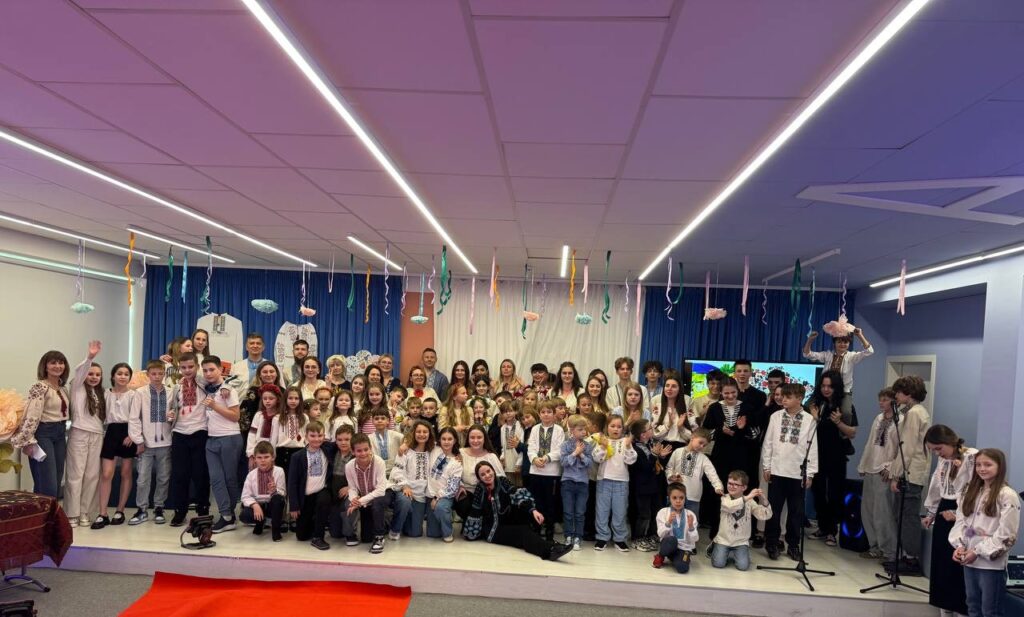
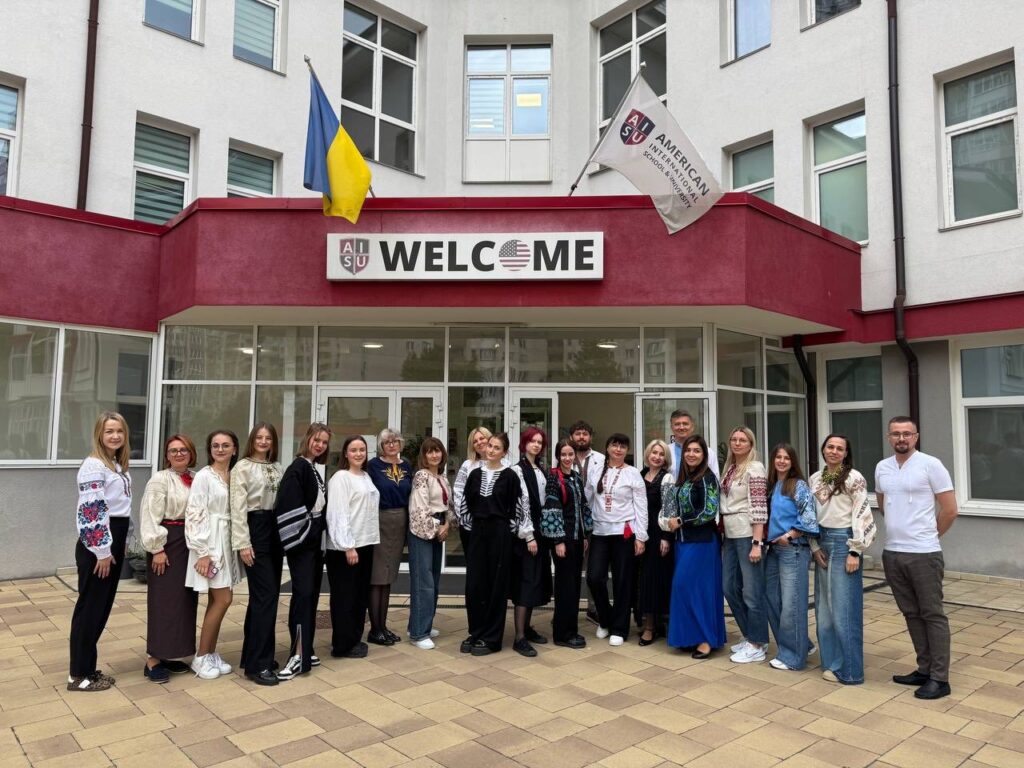
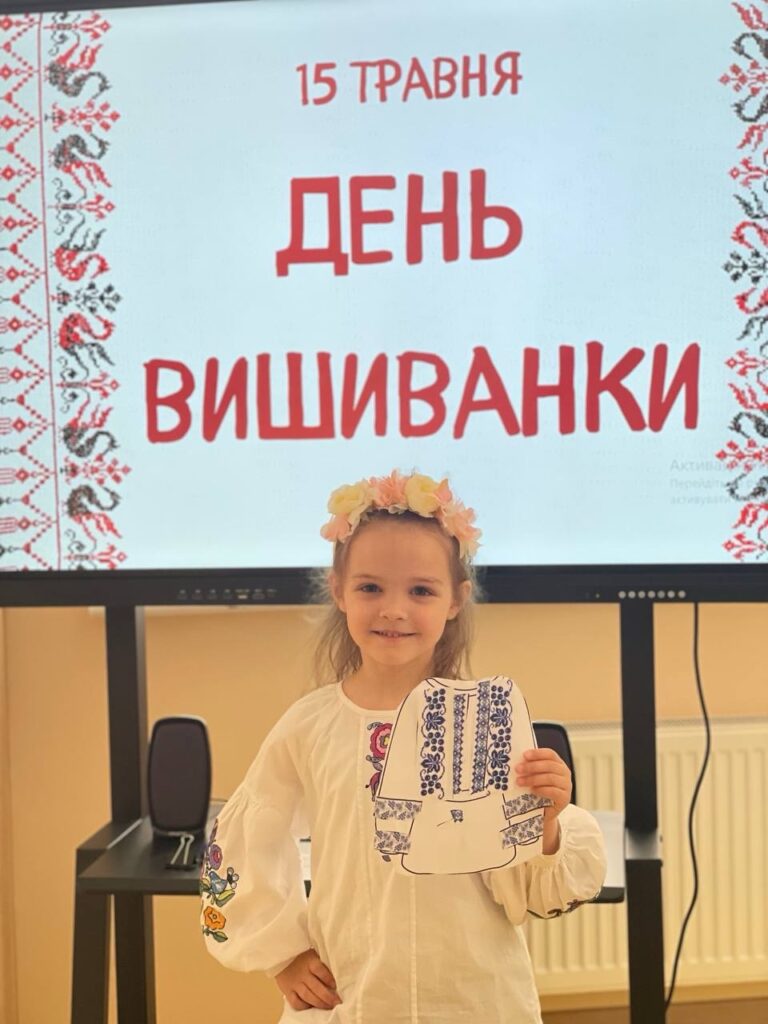
Every nation has symbols imbued with age-old wisdom, worldview and the soul of its ancestors. For Ukrainians, one of these eternal symbols is Vyshyvanka – not just clothes, but a talisman, a deep code of national identity. And every year, on the third Thursday of May, Ukrainians around the world celebrate Vyshyvanka Day. In 2025, this holiday in our AISU private school has acquired a special sound – sincere, bright and truly unifying.
A few days before the holiday, the school began to change. The corridors were decorated with embroidered towels, flower arrangements in blue and yellow colors, paper doves of peace and children’s drawings on the theme of embroidery. The atmosphere of warmth and inspiration reigned everywhere – from preschoolers to high school students, from teachers to the administration.
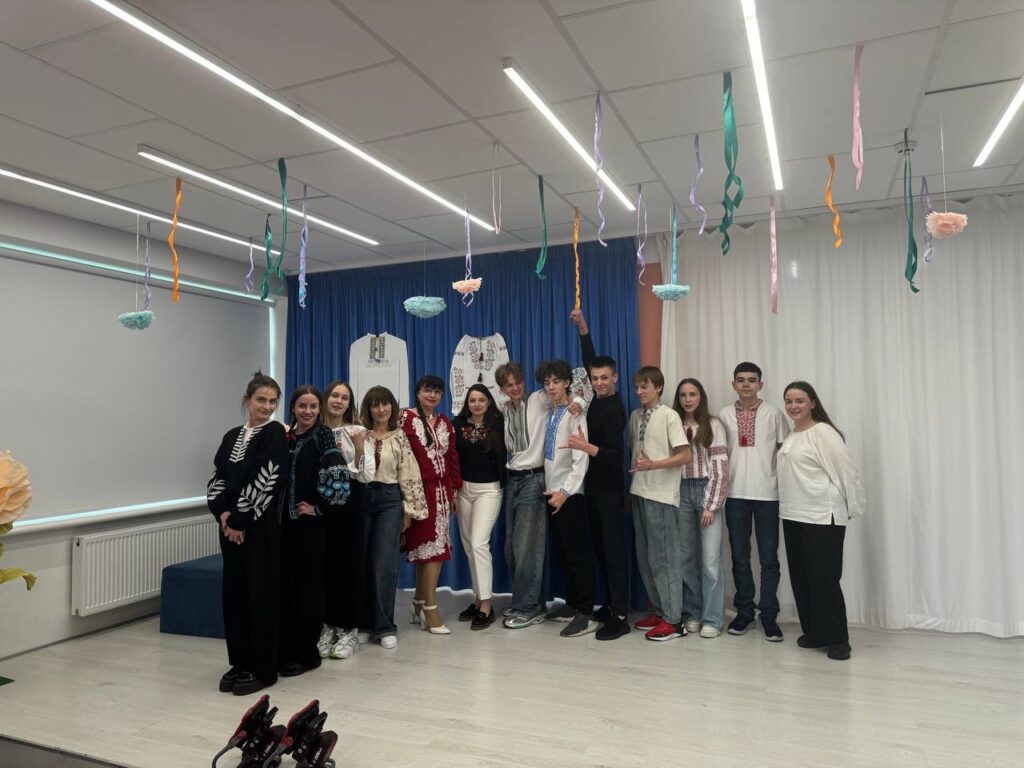
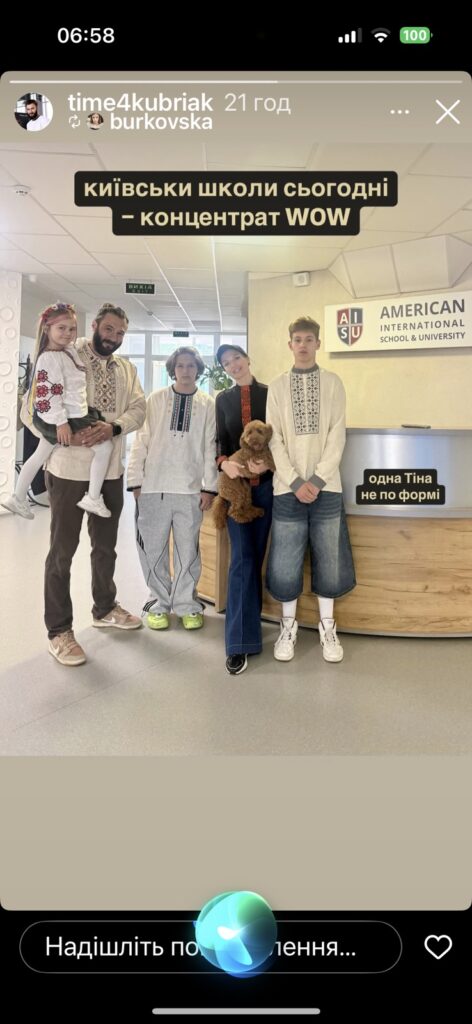
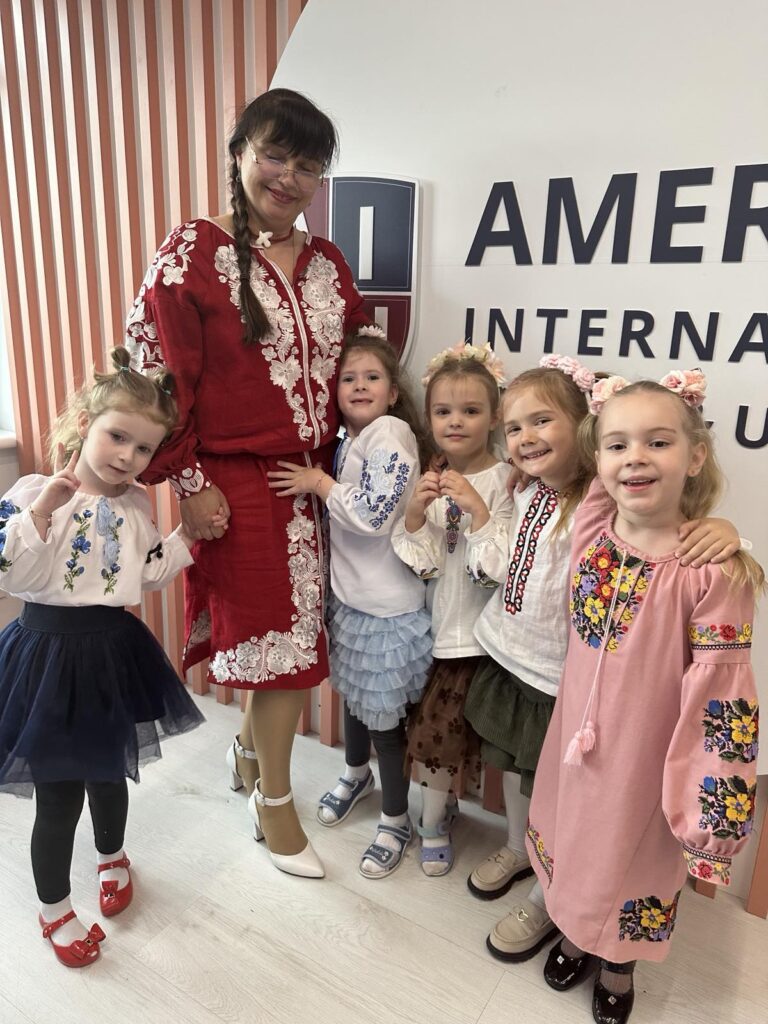
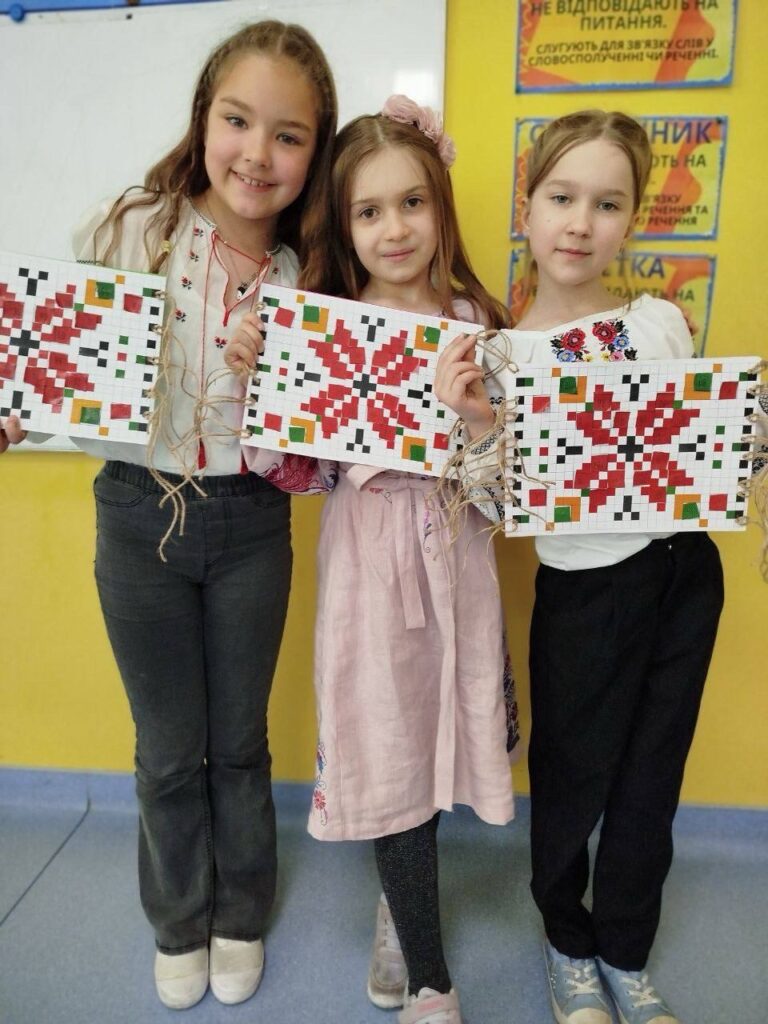
On the very day of the celebration, the AISU school turned into a real ethno-space. Everyone – children, teachers, parents-came in vyshyvankas. These were not just traditional ornaments – each shirt told its own story: from family chests, donated by grandmothers, brought from the Carpathians or Poltava region, or even embroidered with their own hands. The school space came to life, played with colors – as if the whole of Ukraine had gathered in one place.
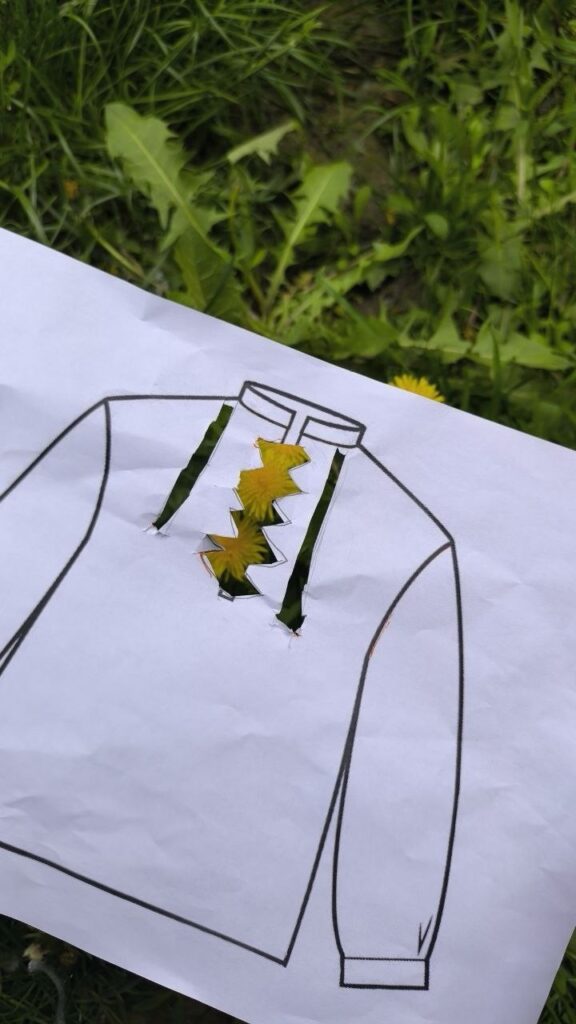
In the first half of the day, students took part in thematic class hours. Junior classes listened to interactive fairy tales about the origin of embroidery, learned what the symbols in the patterns mean, and why embroidery was a talisman. A workshop on embroidery symbols was organized for middle and high schools – students studied ornaments by region, analyzed how colors and shapes affect the energy of clothing.
Especially interesting was the lecture “code of the nation in Vyshyvanka”, which was conducted by Oksana, a history teacher. She not only spoke about the origins of the tradition, but also drew parallels between Ukrainian patterns and modern scientific ideas about geometry, waves, and information codes. The students were amazed that our culture is so deep and scientifically based, and not just aesthetically beautiful.
After the educational part, art came to life in full glory. A fair of craftsmen opened in the school courtyard, where students and parents exhibited their works: handmade jewelry, motank dolls, miniature embroidered towels, patriotic accessories. There were creative master classes – on painting gingerbread in the form of embroidery, making wreaths, drawing the Ukrainian landscape.
The most anticipated event was the fashion performance “embroidered history” – a real fashion show of students in vyshyvankas with a presentation of each region of Ukraine. Children in hutsul, Podolsk, Poltava, slobozhansky costumes appeared on the stage. To the music of folk songs, they talked about the traditions of their great-grandfathers, about the symbols on their shirts, about the spirit of invincibility of the Ukrainian people.
All events ended with a joint flash mob – students, teachers and parents stood in a Big “Living Heart”, holding hands. In the center – the flag of Ukraine, and around – the rhythmic singing of a Ukrainian folk song, which united everyone, regardless of age, origin or language habit. There was a feeling that we were not just a school family, but part of a large living body of the nation.
Vyshyvanka Day at AISU left not only pleasant photos and memories, but something much more – a sense of roots, confidence in our uniqueness, pride in who we are.
Because it is in them that what is not measured by EIT points comes to life – the soul of the Ukrainian spirit, which lives in children’s eyes, in the stitch of embroidery, in the barely noticeable smile of the grandmother in the photo.
AISU is a school where traditions matter, and the future is built on love for one’s own.
m. Kyiv, Drahomanova 1-B, AISU
p. Khodosivka, str. Feodosiya Pecherskyi, 55


